
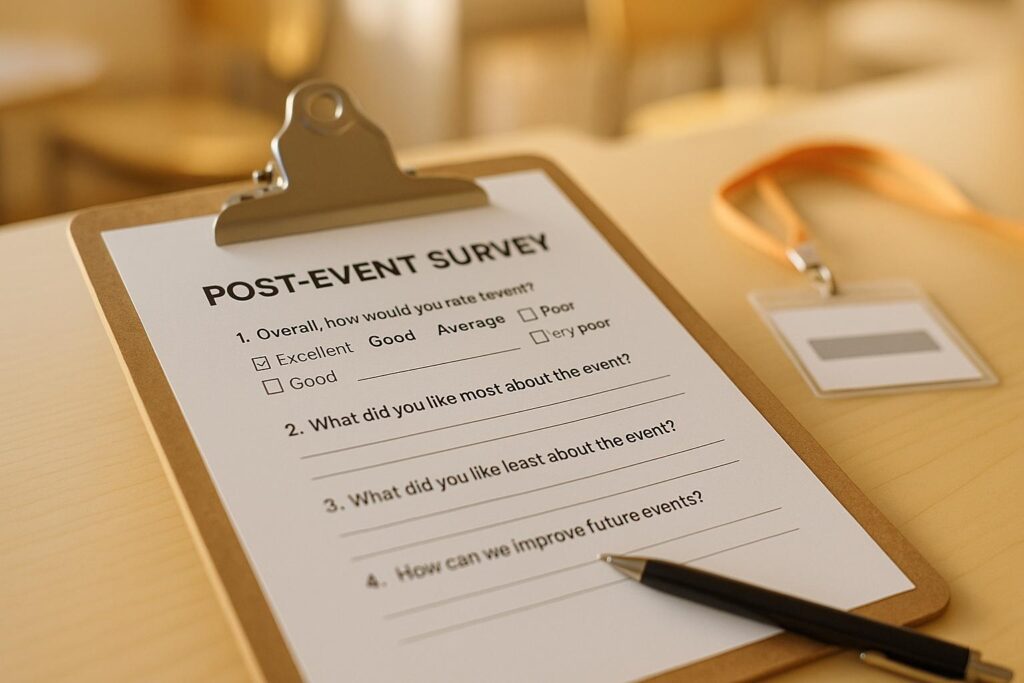
Want better events? Start with the right feedback. Post-event surveys are the key to understanding what worked and what didn’t. They help you collect data from attendees, speakers, vendors, and staff to improve future events. The best time to send them? Within 24–48 hours after the event, while memories are still fresh. Keep surveys short (around 10 questions), use clear language, and mix question types like ratings, multiple-choice, and open-ended. Tailor questions to your event goals – whether it’s networking, education, or entertainment – and target different groups with customised surveys. Use email, QR codes, or social media to distribute them, and boost response rates with incentives like discounts or exclusive content. Once you’ve gathered feedback, analyse the data to identify patterns, prioritise fixes, and share results transparently with stakeholders. This process ensures every event gets better than the last.
18 Post-event Survey Questions to Ask Your Attendees
Why Post-Event Surveys Are Important
Post-event surveys give you clear evidence about whether your event achieved its goals. Without this feedback, you’re left guessing about what worked and what didn’t, which makes it harder to justify decisions or show value to stakeholders for future events.
Survey data turns vague opinions into measurable insights. For example, asking attendees to rate their overall experience on a scale from 1 to 10 provides a benchmark. A low score signals an area that needs attention. This kind of specific, measurable feedback is the starting point for making targeted improvements.
Surveys also go beyond numbers to uncover the reasons behind attendee satisfaction or dissatisfaction. For instance, if catering gets a poor rating, a follow-up question like, "What could we improve about the catering?" might reveal issues like food quality or slow service – giving you actionable information.
How Feedback Measures Event Success
Survey results are crucial for assessing whether your event met its specific goals. If your objective was to encourage networking, you can ask attendees if they made meaningful connections. If the focus was on education, you can gauge whether participants learned something new or picked up practical skills. Collecting feedback within 24–48 hours ensures the responses are fresh and accurate, making it easier to measure success against your event’s objectives.
Tracking the same types of questions across multiple events can help you identify patterns over time. For example, if satisfaction with a venue consistently scores lower than other aspects, it points to a recurring issue that needs fixing. On the other hand, if attendees regularly praise interactive elements, it’s a clear strength worth building on.
While the numbers tell you what happened, the comments explain why. This combination of data and context provides a roadmap for making targeted improvements.
Surveys also help you understand the needs of different attendee groups. Including demographic questions – like whether someone is a first-time visitor or a repeat attendee – can show if satisfaction levels differ between groups. This insight can inform decisions about offering varied formats or experiences to cater to diverse preferences.
Strengthening Relationships with Stakeholders
A well-thought-out survey shows stakeholders that their opinions matter. When attendees see that their feedback influences future planning, it builds trust and leaves them feeling valued – reinforcing that their experience matters even after the event ends.
Ending your survey with a thank-you message and explaining how their input will shape future events leaves a positive impression. Sharing the results – such as highlighting changes made based on past feedback – demonstrates transparency and shows attendees, sponsors, and exhibitors that their input has a real impact. This openness not only encourages participation in future surveys but also strengthens overall engagement with your events.
Customising surveys for different stakeholder groups can further enhance these relationships. General attendees might be asked about their overall experience, while VIPs, speakers, and vendors could receive questions tailored to their unique roles. This personalised approach shows you value the distinct perspectives of each group.
Setting Clear Survey Goals
Before crafting survey questions, it’s crucial to define clear objectives. Without a clear purpose, your questions might lack focus, making the feedback less useful. Each question should connect directly to your event’s goals, ensuring the insights gathered can inform future decisions.
Think about what you want to learn. For example, if your event aimed to showcase new products, focus on how attendees perceived those products and whether the demonstrations worked. If networking was a priority, ask whether attendees made meaningful connections. These targeted questions keep your survey relevant and actionable.
A helpful framework to guide your questions is the 5 W’s: Who attended, what was evaluated, when issues occurred, where problems surfaced, and why attendees felt satisfied or disappointed. This approach ensures you address all key areas without veering off course.
Avoid filler questions. If a question doesn’t help you make decisions for future events, cut it. Aim for a concise survey – around 10 questions – to encourage completion. Tailor your questions to the type of event. For instance:
- Corporate events: Ask, "Did this event increase your awareness of our organisation?" or "Are you interested in following up with any contacts you made?".
- Educational events: Focus on practical outcomes, such as, "Will you apply what you learned at this event to your work?".
By aligning each question with your event’s goals, you’ll collect feedback that’s both relevant and actionable.
Matching Survey Questions to Event Goals
To ensure your survey provides meaningful insights, map each question to your event’s objectives. This prevents gathering generic satisfaction ratings that don’t lead to specific improvements.
For example, if you introduced a new venue layout or interactive sessions, include questions about these changes. If keynote speakers were a major investment, ask attendees about the speakers’ effectiveness and the relevance of their content. Similarly, if you tested a new registration system, evaluate its ease of use and the clarity of pre-event communications.
Focus on three to five key success factors for your event. These should guide your top survey priorities. Secondary questions, like general satisfaction metrics or demographic details, can help with segmentation but shouldn’t dominate the survey. Keep the scope manageable to maintain clarity and engagement.
Your survey should cover the entire event experience, broken into three phases:
- Before the event: Ask about registration ease, communication clarity, and venue accessibility.
- During the event: Cover logistics, catering, speaker quality, session relevance, networking opportunities, and overall atmosphere.
- After the event: Gauge whether attendees would recommend the event and their likelihood of attending again.
Use a mix of quantitative and qualitative questions for a well-rounded perspective. For instance, rating scales and yes/no questions provide numerical data for trend analysis, while open-ended questions reveal attendee reactions in their own words. A balanced approach helps you identify not just what went wrong but why.
For example, pair a 5-point rating scale on venue satisfaction (quantitative) with an open-ended question like, "What could we improve about the venue?" (qualitative). This combination highlights key issues through numbers and provides detailed attendee feedback.
Choosing Who to Survey
Once your survey goals are set, identify the stakeholder groups you’ll target. Gathering input from all relevant groups ensures you capture diverse perspectives and can address success across all aspects of the event. Each group has unique priorities, so tailoring questions to their roles is essential.
- Primary attendees: These are your main audience. Ask about their overall experience, session quality, and satisfaction levels. Include demographic questions to segment responses by factors like age or whether they’re first-time or repeat attendees. This segmentation can reveal trends and help you tailor future events to different groups.
- Sponsors and vendors: Focus on lead generation opportunities, visibility, and return on investment.
- Staff and volunteers: They offer behind-the-scenes insights that attendees might not notice but are crucial for smooth event delivery.
- VIP guests and keynote speakers: Customise surveys to reflect their unique experiences and any special arrangements.
When surveying diverse groups, consider letting respondents choose whether to remain anonymous. Some people may feel more comfortable sharing honest feedback anonymously, while others may welcome follow-up conversations about their suggestions.
Finally, be transparent about why you’re collecting feedback. Let respondents know how their input will be used. For example, include a note in your survey introduction: "Your feedback will directly inform our planning for next year’s event, including venue selection, session formats, and catering choices." This clarity can motivate people to participate, knowing their opinions will make a difference.
Writing Good Survey Questions
Once you’ve aligned your survey with your event goals, the next step is crafting clear and focused questions. Good questions lead to meaningful feedback, while unclear ones can result in confusing or unhelpful responses. The goal is to ask questions that give you actionable insights to improve future events.
Use simple, straightforward language. For instance, instead of asking, "How would you evaluate the efficacy of our logistical coordination?" say, "How easy was it to find your way around the venue?" The simpler phrasing makes it easier for respondents to understand and provide honest answers.
Stick to one topic per question. Avoid combining multiple elements into a single question, like, "How satisfied were you with the venue and catering?" If someone rates this poorly, you won’t know which aspect they found lacking. Break it into two separate questions for clarity. Also, avoid vague questions like "Was the event good?" Instead, be specific: "How would you rate the event’s organisation?" along with a clear scale. This approach ensures responses are both precise and helpful.
Keep your questions neutral. Avoid leading respondents toward a particular answer. For example, instead of asking, "Didn’t you find the venue disappointing?" try, "What aspects of the venue could be improved?" Neutral wording encourages genuine feedback without biasing the response.
Randomise response options on scales to avoid bias. When using rating scales, respondents might unconsciously favour the first or last option. Randomising the order ensures that the results reflect their true opinions and not just the quirks of survey design.
Keep your survey concise – aim for a completion time of 5–10 minutes. While it’s essential to gather all the necessary feedback, a long survey can overwhelm participants and lead to lower completion rates. Surveys with 8–15 well-thought-out questions tend to strike the right balance between thoroughness and brevity.
Selecting Question Types
The type of question you choose plays a big role in the quality of your data. Different formats are suited to different purposes, and mixing them up keeps respondents engaged while providing a variety of insights.
Rating scale questions are great for measuring satisfaction or opinions. Use a consistent scale throughout your survey, such as a 5-point range from "Very Dissatisfied" to "Very Satisfied." Always label each point clearly (e.g., "1–Very Dissatisfied, 2–Dissatisfied, 3–Neutral, 4–Satisfied, 5–Very Satisfied"). This ensures respondents interpret the scale consistently, making the data easier to analyse.
Multiple-choice questions are ideal for gathering preferences or specific details. For example, "Which sessions did you attend? (Keynote, Breakout Session, Panel Discussion)" helps you track participation. Make sure the options are distinct and don’t overlap to avoid confusion.
Open-ended questions let participants share detailed thoughts in their own words. Questions like "What was your favourite part of the event?" or "What could we improve for next time?" can uncover insights you didn’t anticipate. Provide ample space for responses to encourage thoughtful answers.
Yes/no questions are quick and effective for identifying specific issues. For instance, "Was the venue easy to navigate?" can quickly flag potential problems. However, these questions are limited in detail, so consider adding follow-ups. For example, if someone answers "No", ask, "What made navigation difficult?"
For low ratings, include follow-up questions to gather more context. If someone rates the venue as "Poor", ask, "What specific issues did you encounter?" This approach turns a simple rating into actionable feedback, helping you pinpoint the exact problem.
Vary your question types to keep the survey engaging. Alternating between rating scales, multiple-choice, and open-ended formats prevents monotony. Place simpler questions at the start and save more detailed ones for later, creating a natural flow that encourages respondents to complete the survey.
Avoiding Question Design Mistakes
Even with clear question types, certain design flaws can skew your results. Avoid these common mistakes to ensure your survey captures accurate, unbiased feedback.
Don’t use overlapping response options. For example, asking, "How often do you attend industry events?" with choices like "Frequently, Often, Regularly, Sometimes" creates confusion because the terms overlap. Instead, use distinct options like "Weekly, Monthly, Quarterly, Annually, This was my first event."
Avoid leading questions. Phrasing like, "Our keynote speaker was inspiring, wasn’t they?" pressures respondents to agree. A better approach is, "How would you rate the keynote speaker’s presentation?" with a balanced scale from "Poor" to "Excellent."
Break down compound questions. Asking, "How satisfied were you with the registration process and pre-event communications?" combines two separate topics. If someone answers negatively, you won’t know which aspect they’re unhappy with. Split these into individual questions for clarity.
Use simple, clear wording. Avoid technical jargon or overly complex phrasing. For example, "Did you learn useful information from the sessions?" is much clearer than, "How would you evaluate the pedagogical efficacy of the educational sessions?"
Include all relevant answer options. If you ask, "How did you hear about this event?" but only list online channels, you might miss out on responses like word-of-mouth. Always include an "Other (please specify)" option for such questions.
Avoid irrelevant questions. Every question should serve a purpose. For instance, asking attendees about their favourite colour might be fun, but it doesn’t help improve your event. Stick to questions that align with your goals.
Use balanced scales. A satisfaction scale like "Excellent, Very Good, Good, Acceptable, Poor" leans heavily positive. Instead, use equal options on both sides, such as "Very Satisfied, Satisfied, Neutral, Dissatisfied, Very Dissatisfied."
Before launching your survey, test it with a small group to catch unclear or problematic questions. Ask testers to think aloud as they respond, revealing any ambiguities or potential issues. This step helps refine your survey for better results.
Group related questions into sections for easier navigation. For example, organise questions under categories like "Registration", "Venue", or "Content and Speakers." This structure makes the survey feel more logical and professional.
Finally, balance questions about challenges with those highlighting positives. For example, ask, "What was your favourite part of the event?" alongside, "What could we improve?" This ensures the survey captures both successes and areas for growth, leaving respondents with a balanced impression.
sbb-itb-9167268
When and How to Send Your Survey
Send out your survey promptly while the event is still fresh in attendees’ minds. Both the timing and the method of delivery play a big role in how many people respond and the quality of the feedback they provide.
Best Time to Send Post-Event Surveys
Aim to send your survey within 24 to 48 hours after the event ends. This is the sweet spot for gathering accurate and detailed feedback since people’s memories and emotional reactions are still fresh. For instance, if your event finishes on a Friday evening, try to send the survey by Saturday morning or Sunday at the latest.
To maximise responses without overwhelming participants, follow a clear reminder schedule:
- Send the initial survey within 24–48 hours.
- Follow up with a first reminder 3–5 days later.
- Send a final reminder 10–14 days after the event.
Stick to no more than three reminders in total to respect attendees’ time. For events in Australia, avoid sending reminders during peak work hours, like early Monday mornings or late Friday afternoons. Adjust your timing based on the event type – for example, send immediate follow-ups for virtual sessions or staggered surveys for multi-day conferences. For such conferences, it can be effective to send session-specific surveys right after each major session instead of waiting until the entire event wraps up.
Once your timing is set, focus on the best ways to distribute your survey to ensure maximum participation.
How to Distribute Your Survey
Even a well-designed survey needs the right distribution strategy to succeed. Using multiple channels increases its reach and makes it accessible to all attendees. Online surveys generally perform better than paper-based ones, but a mix of methods can cater to different preferences. Here are some effective options:
- Email Invitations: Send a personalised email with a warm thank-you message, a clear explanation of how the feedback will be used, and an estimated completion time (e.g., "This survey takes about 5 minutes"). Including a progress bar in the survey can also lower abandonment rates.
- QR Codes: Display QR codes on presentation slides, event signage, or near the exit to encourage immediate feedback. These codes should link to a mobile-friendly survey for convenience.
- Social Media Reminders: For events with a community focus, social media posts can serve as friendly reminders to complete the survey.
Tailor your approach to your audience. Older attendees or those less familiar with technology may prefer email links, while younger or tech-savvy participants might respond better to QR codes or social media prompts. For corporate events, embedding the survey into event management platforms or company emails can ensure higher visibility.
Promote the survey during the event itself to build awareness. Mention it in closing remarks, display links or QR codes in presentations, and include them in event materials to highlight its importance. A sense of urgency – like a countdown timer in follow-up messages – can encourage quicker responses without being overbearing.
To increase participation, offer the option for anonymous responses, especially for feedback on sensitive topics. Track key metrics like response rates, completion rates, and the effectiveness of each distribution method. This data can help you fine-tune your approach for future events. After the survey, send a thank-you note along with a summary of key findings to show attendees that their input matters. This not only builds trust but also encourages ongoing engagement.
Increasing Survey Response Rates
To get more people to complete your surveys, you need to actively promote them and offer enticing incentives. Higher response rates lead to more reliable data, which means better insights for improving future events.
Keep surveys short – around 10 questions – to respect attendees’ time and boost completion rates. Surveys that exceed 15 questions often see a drop in responses as participants lose interest. Adding a clear time estimate, like "This survey takes 2–5 minutes", along with a progress bar, can help reduce survey abandonment.
When inviting attendees to participate, use a friendly and concise message that explains the survey’s purpose and expresses gratitude. For instance, you could highlight how their feedback will directly improve future events. This not only shows respect for their time but also makes them feel their input is meaningful.
On top of good survey design, targeted incentives can make a big difference in encouraging participation.
Using Incentives to Boost Participation
Choosing the right incentives can significantly increase response rates. Options like branded merchandise, discounts for future events, free tickets, prize draws, or exclusive access to event content (e.g., keynote videos or slide decks) can motivate attendees without compromising the survey’s purpose. The cost of these incentives can vary depending on the event. For example, corporate events might offer branded items or vouchers worth AUD $5–$25 per person, while larger conferences may find raffle prizes or exclusive content access more cost-effective.
Tailor the incentives to suit your audience. Corporate attendees might value professional development resources or networking opportunities, while wedding guests might appreciate discounts on photography or entertainment services. To refine your approach, track which incentives work best by comparing completion rates across different strategies and distribution channels.
Once you’ve gathered responses, close the feedback loop by showing attendees how their input has led to improvements. A thank-you landing page with event highlights or exclusive content is a great way to express appreciation and reinforce the value of their feedback.
Promoting the Survey at Your Event
Promoting your survey during the event itself is essential for boosting participation. When attendees are aware of the survey beforehand, they’re more likely to complete it when the follow-up invitation arrives. Use closing remarks or final sessions to announce the survey, and provide a direct link or QR code that attendees can scan on the spot. You can also display survey links on presentations, signage, and printed materials throughout the event.
For virtual or hybrid events, include survey links in follow-up emails sent within 24–48 hours. Social media reminders during and after the event can also reach attendees who prefer digital communication. Posts with countdowns, reminders about the survey’s closing date, and event-specific hashtags can help create urgency and drive responses.
To accommodate different preferences, use multiple distribution channels. While some attendees may prefer email, others might respond better to QR codes or social media prompts. Keep the survey engaging by varying question types, and consider maintaining a consistent set of questions across events to track trends over time.
Event management software can make the process even smoother. It can automate survey scheduling, personalise communications at scale, optimise surveys for mobile users, and distribute them through multiple channels. This ensures attendees receive the survey at the right time without requiring manual effort.
Analysing Survey Data and Using Feedback
Once you’ve gathered responses from your survey, the next step is turning that data into practical improvements for future events. Raw feedback is just the starting point – you need to organise and interpret it to uncover actionable insights that can genuinely enhance your next event.
Start by sorting your data. Quantitative data (like ratings or numerical scores) provides an overall view, while qualitative data (comments and suggestions) explains the "why" behind those numbers. Both types are essential, but they require different approaches to extract meaningful insights.
Understanding Survey Results
The first step in analysing survey results is to group responses into clear categories. Common categories include satisfaction levels, content quality, and logistical feedback.
For quantitative data, calculate averages and look at the distribution of responses. For example, if attendees rated your event on a scale of 1 to 10, find the average score and identify where responses tend to cluster. Clusters of low scores, for instance, might point to areas needing immediate attention. This distribution often tells a richer story than the average score alone – an event averaging 8 may feel very different depending on whether most scores are clustered around 8 or split between 3s and 10s.
Segment your data by attendee type, as different groups often have distinct priorities. For instance, general attendees may focus on the overall experience, while vendors are more concerned with foot traffic and lead generation. Similarly, corporate guests might prioritise networking opportunities, while speakers care about session logistics.
Pay close attention to repeated themes in qualitative feedback. If multiple attendees mention the same issue – like poor signage, confusing schedules, or uncomfortable seating – you’ve likely identified a systemic problem. These recurring themes often emerge from open-ended questions and can explain why certain aspects received low numerical ratings. For example, if venue comfort scored poorly, comments might reveal whether the issue was temperature, seating, or acoustics.
Use data visualisation tools to simplify complex findings. Bar charts can illustrate satisfaction levels across various aspects of the event, while word clouds can highlight frequently mentioned themes in written feedback. Heat maps are particularly effective for identifying strong and weak areas, making it easier to communicate findings to your team and stakeholders.
Compare your survey results against your initial event objectives to measure success. For instance, if your goal was to foster connections but attendees felt isolated, this gap needs immediate attention. Similarly, if you aimed to educate attendees but feedback shows confusion, your content strategy likely needs rethinking.
Tracking trends over time is also critical. Compare results with past events to see if changes you made were effective or if new issues have arisen. For instance, if you upgraded catering based on last year’s feedback, check whether satisfaction scores improved. Documenting these changes helps you link specific actions to measurable outcomes.
These insights set the stage for targeted improvements, which we’ll explore next.
Applying Feedback to Future Events
When prioritising feedback, focus on both frequency and impact. If 30% of attendees report the same issue, it’s a clear sign of a widespread concern that needs addressing.
Organise feedback based on urgency and ease of implementation. Quick fixes with high impact – like improving signage if attendees found it confusing – should come first. On the other hand, issues affecting only a small group or requiring significant resources might be lower priority unless they align with your core objectives.
Consider the severity of issues as well. Problems like poor food quality or safety concerns demand immediate attention, while suggestions for minor aesthetic changes can wait. Accessibility concerns, such as inadequate wheelchair access or lack of hearing assistance, should always be addressed urgently to ensure inclusivity.
Align your efforts with your event goals. For example, if your primary aim was to encourage networking but attendees struggled to connect, this feedback should take precedence over other less critical issues. Improvements should directly support your main objectives.
Create a detailed action plan that assigns responsibilities and sets measurable targets for the top issues. For example, if long registration queues were a problem, your plan might include implementing express check-ins to reduce wait times from 15 minutes to under 5 minutes. Clear goals make it easier to measure success.
Some feedback may point to budget limitations. If attendees consistently request better catering or more engaging speakers, you might need to reallocate funds or justify additional investment. Presenting concrete feedback to decision-makers can strengthen your case for increased resources.
Document every change you implement – what you adjusted, when, and at what cost. This not only helps with future planning but also demonstrates accountability to stakeholders. It ensures you don’t lose track of what worked (or didn’t) when planning future events.
Once your priorities are set, it’s time to share your findings.
Sharing Results with Stakeholders
Tailor your reports to different audiences – attendees, sponsors, and your internal team – using clear visuals and actionable insights.
For attendees, show that their feedback matters by sharing a post-event report. Highlight how previous feedback led to specific improvements. This not only builds trust but also encourages future participation.
Send follow-up messages thanking respondents and explaining how their input will shape future events. Closing the feedback loop shows attendees you’re listening, making them more likely to provide thoughtful responses in the future.
For sponsors and funding partners, focus on metrics that align with their goals. Highlight how attendee satisfaction translates to brand loyalty or increased exposure. For example, if 85% of attendees rated the event as good or excellent, present this as evidence of strong audience engagement.
For your internal team, hold a debrief meeting to review survey data, celebrate successes, and brainstorm solutions for challenges. Acknowledge what went well – like positive feedback on registration or speaker quality – to maintain morale. Use this session to reinforce best practices while addressing areas for improvement.
Present findings in varied formats to suit different preferences. Email summaries work for stakeholders who need quick highlights, while detailed reports and presentation slides are better for in-depth reviews. Visuals like charts and graphs make complex data easier to digest.
When sharing results, provide a balanced view by highlighting both successes and areas for improvement. Be transparent about negative feedback, framing it as an opportunity to grow. This honest approach builds credibility and shows your commitment to making things better.
Finally, maintain anonymity in survey responses, especially for sensitive topics. Aggregate feedback into themes rather than sharing individual comments to protect privacy and encourage honest input in future surveys.
The goal of this entire process is to turn survey data into concrete actions. By doing so, you ensure your next event not only meets but exceeds expectations.
Conclusion
Post-event surveys play a crucial role in identifying what went well, what needs improvement, and how to make your next event even better. Without structured feedback, you’re left relying on guesswork instead of actionable insights.
A well-planned survey process – from thoughtful design and timely distribution to thorough analysis and follow-up action – lays the groundwork for meaningful event enhancements. It’s important to gather input from all key stakeholders to ensure every aspect of your event is covered.
Keep your surveys concise and targeted, aiming for 5–15 questions depending on the complexity of your event. Once you’ve collected responses, the real work begins: acting on the feedback. Share the results with stakeholders and show how past survey insights led to tangible improvements. When attendees see their input resulted in better seating arrangements, upgraded catering, or more engaging activities, they’re more likely to provide genuine feedback in the future.
Tracking trends across multiple events is equally important. It helps you identify patterns in attendee satisfaction, venue performance, and service quality. Over time, these incremental adjustments lead to noticeable improvements in your event planning.
By incorporating these survey practices into your post-event routine, you’ll gain insights that enhance every detail of your planning process. From venue selection to service providers and overall attendee experience, these small but consistent steps can transform your events.
At One Click Events, we embrace this approach in every post-event review, ensuring that each event is not just memorable but continually improving.
FAQs
How can I boost response rates for post-event surveys?
To boost response rates for post-event surveys, aim to keep the survey concise and to the point – no longer than 5 minutes. Use straightforward, engaging language, and where possible, personalise the survey by addressing attendees by name.
Timing is key. Send the survey soon after the event, ideally within 24–48 hours, while the experience is still fresh in attendees’ minds. Adding a small incentive, like a discount for future events or entry into a prize draw, can further motivate people to participate.
Make the survey easy to access by including a direct link in your follow-up emails, SMS messages, or even posting it on social media. Also, ensure the survey is mobile-friendly to encourage responses from participants who may prefer to complete it on their phones.
How can I create survey questions that reflect the goals of my event?
To make sure your survey questions truly reflect your event’s goals, start by pinpointing what you want to measure – whether it’s attendee satisfaction, event logistics, or the success of specific activities. Your questions should directly tie back to these objectives, and it’s crucial to keep them clear, straightforward, and easy to answer.
For instance, if you’re aiming to assess attendee engagement, you might ask: "How engaging did you find the activities during the event?" or "Which session or activity stood out the most for you?". Steer clear of vague or overly complicated questions, as they can lead to unclear or less useful responses.
Thoughtfully designed questions can provide insights that help you fine-tune future events, creating even better experiences for your attendees.
How can I effectively analyse and act on feedback from post-event surveys?
To get the most out of feedback from post-event surveys, start by organising responses into clear categories like event logistics, entertainment, or overall satisfaction. Tools such as spreadsheets or survey platforms can help you spot trends, recurring concerns, and standout positive comments with ease.
After breaking down the data, focus on actionable insights. For instance, if attendees mention long wait times, you might look into improving the check-in process or hiring additional staff for future events. Taking action based on feedback not only shows you value your guests’ opinions but also helps create a better experience next time.
If you’re aiming for a hassle-free event, check out One Click Events. Based in Melbourne, they provide everything from photo booths to professional photography. Their all-inclusive packages can help ensure your event runs smoothly and leaves a lasting impression on your guests.