

When planning an event, selecting the right dance floor is crucial for safety, comfort, and protecting the venue. Here’s what you need to know:
- Guest Safety: Prioritise slip-resistant surfaces and stable foundations to prevent accidents, especially for guests in formal shoes.
- Venue Protection: Use flooring that prevents damage to underlying surfaces, particularly in indoor spaces.
- Indoor vs Outdoor: Indoor floors need grip and protection for existing surfaces, while outdoor floors must handle uneven terrain, moisture, and weather changes.
- Material Options:
- Vinyl: Waterproof and versatile but can be slippery when wet.
- Wood: Elegant with natural spring but sensitive to moisture.
- Carpet: Comfortable with good grip but hard to clean and unsuitable for outdoor use.
- Safety Features: Look for bevelled edges, non-slip coatings, water resistance, and interlocking panels for stability.
- Load Capacity: Ensure the floor can handle the expected weight, adhering to Australian standards (e.g., 5.0 kPa for dance halls).
- Installation: Ensure a level base, secure panel connections, and smooth transitions to prevent hazards.
- Compliance: Check local safety regulations, permits, and insurance requirements to meet Australian standards.
Key Tip: Always conduct a thorough site inspection and pre-event safety checks to ensure the floor is secure, level, and hazard-free.
Choosing the right dance floor not only ensures safety but also enhances the overall event experience.
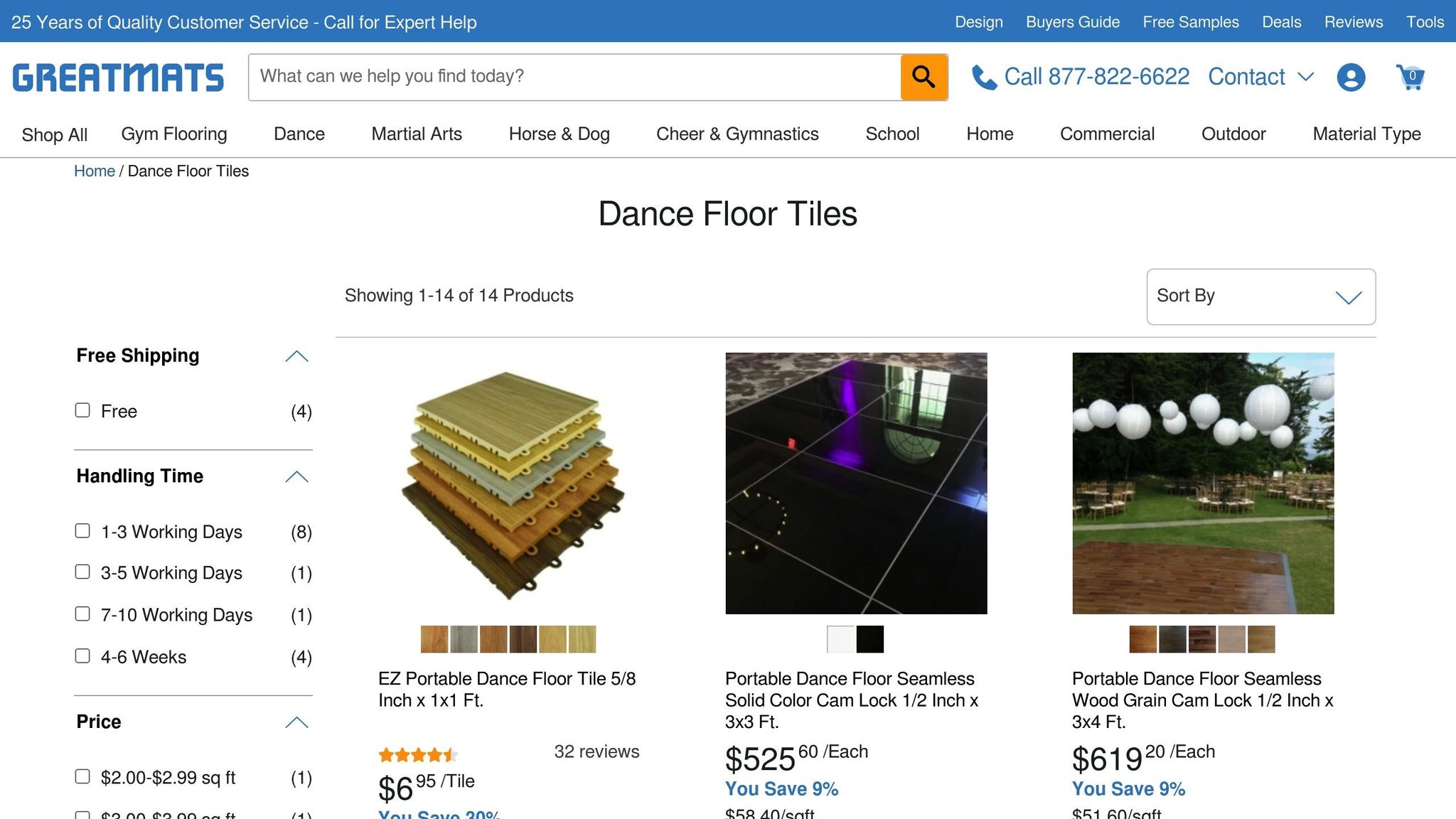
EZ Portable Dance Floor – Greatmats Modular Dance Floor Tiles
Evaluating Your Venue and Event Needs
Choosing the right dance floor starts with understanding your venue and the specific requirements of your event. By carefully assessing the venue’s conditions and the event’s unique needs, you’ll be better equipped to select a flooring solution that works seamlessly. This process also helps you decide whether indoor or outdoor flooring is the better fit.
Start with a thorough site inspection. As Social Tables wisely points out:
"A site inspection checklist helps event planners remember every detail, no matter how small, when visiting a venue."
This step ensures you catch details that photos or online descriptions might miss, such as hidden obstacles or specific requirements for the space.
Indoor vs Outdoor Venues
Indoor venues come with more predictable conditions, but they still require careful consideration. Protecting the existing floors is often a priority, so you’ll want a dance floor that provides enough grip for safety without causing damage. Other factors to keep in mind include ceiling height, lighting, and the venue’s weight limits for temporary installations.
Outdoor venues, on the other hand, bring a host of variables. Weather is a big one – rain, heat, or even uneven ground can all pose challenges. You’ll need flooring that can handle moisture, temperature swings, and surfaces like grass, concrete, or sand. Stability is key, especially since guests in formal footwear may find uneven terrain tricky. These factors will guide how you prepare the surface, which we’ll cover next.
Surface Preparation and Stability
The condition of the surface beneath your dance floor is just as important as the floor itself. During your site inspection, pay close attention to the ground where the floor will be installed. Look for uneven areas, debris, or anything else that could compromise stability.
Create a checklist to document the surface type and its condition. For outdoor venues, you might need to clear debris, level the ground, or even build a stable base. Indoor spaces may require protective underlays to safeguard existing floors.
Accessibility is another critical aspect. For instance, corporate events might need smooth transitions and stable edges for guests with mobility aids, while weddings may require extra care for elderly attendees.
Take photos and measurements during your inspection, and note any obstacles or accessibility concerns. Ask venue staff about restrictions or requirements for temporary flooring. Some venues may have specific rules about the type of flooring allowed or require permits and insurance for temporary installations. These details are essential for ensuring a smooth setup and a successful event.
Dance Floor Material Options
When deciding on a dance floor material, it’s important to prioritise safety and consider the specific needs of your event. Different materials come with their own advantages and challenges, so understanding their features will help you pick the best option for your venue and event requirements.
Material Types: Vinyl, Wood, and Carpet
Vinyl floors are a versatile choice. They’re waterproof, provide good grip for various types of footwear, and are easy to clean. Suitable for both indoor and outdoor settings, vinyl can handle everything from air-conditioned venues to hot outdoor conditions without cracking or warping.
Wooden dance floors are known for their natural spring and reliable traction, making them a popular choice for formal or indoor events. However, they require careful protection from moisture, which can be a concern in Australia’s humid or dry climates. Wooden floors are best suited to covered or indoor venues.
Carpeted floors offer excellent grip and comfort underfoot, which can be ideal for smaller, more intimate indoor gatherings. However, carpets are harder to clean and aren’t suitable for outdoor use or events where spills are likely. They can also pose challenges for dance styles that demand smooth, gliding movements.
Choosing the right material means balancing the specific needs of your venue with safety considerations and ensuring compliance with Australian safety standards.
| Material | Best For | Pros | Cons |
|---|---|---|---|
| Vinyl | Indoor and outdoor events | Waterproof, easy to clean, versatile | Can become slippery when wet |
| Wood | Indoor formal events, weddings | Elegant look, natural spring | Sensitive to moisture, requires extra care |
| Carpet | Small indoor gatherings | Comfortable, great grip | Hard to clean, limited to certain event types |
Beyond the material itself, safety features can further enhance the dance floor’s usability and reduce risks.
Safety Features to Look For
Once you’ve selected a material, consider additional safety features to ensure a secure and enjoyable experience.
Edge barriers are essential to prevent trips and falls. Look for dance floors with bevelled edges or transition strips that create a smooth slope from the surrounding surface to the dance floor. This is especially important for raised dance floors.
Non-slip coatings are a must, particularly for outdoor events. Many vinyl options come with textured surfaces to improve grip without compromising comfort. For wooden floors, avoid finishes that are overly glossy, as they can become slippery, especially with formal footwear.
Water resistance is critical for Australian events, even those held indoors. Factors like air conditioning condensation, spilled drinks, or unexpected weather can introduce moisture to the floor. Choose materials that repel water or can be dried quickly without damage.
Interlocking systems enhance stability by securely connecting individual panels, reducing the risk of sections shifting or separating. This is particularly useful for outdoor events where uneven ground or movement could pose challenges.
Load distribution features help evenly spread weight across the floor, preventing sagging or bouncing. Floors with reinforced backing or support structures are especially important for uneven surfaces or when spanning gaps.
Finally, consider temperature resistance, a key factor for Australian conditions. Floors that maintain their safety and functionality in varying temperatures are ideal for events that transition between indoor and outdoor spaces or take place in marquees with limited temperature control.
Weight Limits and Structural Requirements
Understanding your dance floor’s weight capacity is crucial to avoid structural issues and maintain guest safety. If the floor isn’t built to handle the expected load, it could put your event at risk.
Calculating Load Capacity
When planning, factor in the live load – this includes the weight of people, furniture, equipment, and decorations. It’s different from the weight of the floor itself and plays a key role in structural planning.
For venues like dance halls, bars, and lounges, the Australian Standard (AS 1170) specifies a live load capacity of 5.0 kPa (or 5.0 kN/m²). To calculate the total load capacity, multiply the floor area by this figure. For example, a 50 m² floor would need to support 250 kN (50 m² × 5.0 kN/m²).
Keep in mind that live loads will vary depending on how the space is used, so it’s important to account for all unfixed items when assessing the structural needs of the floor.
| Venue Type | Live Load Requirement (kPa) |
|---|---|
| Dance halls, bars, lounges | 5.0 |
| Houses | 1.5 |
| Offices | 3.0 |
| Hospitals, school assemblies | 3.0 |
| Workshops | 5.0 |
Accurate load calculations are essential, and using the correct units makes the process smoother.
Australian Measurement Standards
In Australia, weights are measured in kilograms (kg), areas in square metres (m²), and loads in kilonewtons (kN) or kiloPascals (kPa). For reference, 1 kN is roughly equal to 102 kg. Following these units ensures compliance with local regulations and simplifies communication with suppliers and engineers.
In July 2015, the Australian Building Codes Board (ABCB) released a Standard outlining technical design criteria for temporary structures, including structural safety. This document, titled "Standard-temporary-structures.pdf", can be accessed on their website. However, the application of this Standard for temporary structures, such as event dance floors, is determined by the relevant State or Territory authorities.
Local regulations may impose additional requirements for temporary dance floors, so it’s vital to confirm specifics with your local authority.
For outdoor portable dance floors, ensure the ground is perfectly level to avoid instability.
sbb-itb-9167268
Installation and Pre-Event Safety Checks
Setting up your dance floor correctly and conducting detailed safety checks are essential to ensure it remains secure and functional throughout your event. Even the best materials can fail if the installation is rushed or safety protocols are ignored.
Proper Installation Methods
Start with a level foundation. For outdoor events, make sure any ground variation exceeding 5mm within a 2-metre span is corrected. Indoor venues usually provide a more stable base, but always double-check that the floor is clean and free from debris.
Eliminate gaps between panels. Loose connections can lead to tripping hazards or shifting during use. Most professional dance floors use cam-lock or tongue-and-groove systems. Apply firm pressure to lock panels securely, and test by attempting to lift adjoining sections – they should stay firmly connected and move as a single unit.
Smooth transitions with bevelled edges or ramps. Ensure that any transition between the dance floor and surrounding surfaces has a slope no steeper than 1:8 (7°). This reduces the risk of trips and falls.
Account for expansion in outdoor settings. Leave a 2–3mm gap around the edges of the floor to accommodate expansion caused by heat. Cover these gaps with trim strips to maintain a polished look and prevent buckling during hotter parts of the day.
Once the floor is securely in place, shift your focus to pre-event checks to guarantee safety throughout the event.
Pre-Event Safety Inspections
After installation, a thorough inspection ensures your dance floor is ready for action. This step complements earlier measures like material selection and load capacity assessments, leaving no room for oversight.
Check the floor systematically. Walk across the floor in a grid pattern, inspecting for movement, squeaking, or flexing. Pay close attention to areas where multiple panels join, as these spots often bear the most stress during use.
Test electrical components. If your dance floor includes LED lighting or electrical outlets, ensure all cables are securely fastened and free from obstructions. Loose wires can cause tripping or electrical hazards. All electrical work must comply with AS/NZS 3000 (Australian/New Zealand Wiring Rules).
Document and address issues immediately. If you notice unstable panels, uneven edges, or worn surfaces, record them on a checklist and resolve them before guests arrive. Take photos of any concerns to share with your installation team for quick fixes.
Ensure emergency access remains clear. Confirm that your dance floor layout does not block fire exits or emergency pathways. Emergency lighting and exit signs should be visible from every part of the floor.
Perform a final load test. Have several people walk across different sections of the floor at the same time, mimicking the weight distribution expected during peak use. Listen for any unusual noises, watch for excessive movement, and feel for instability underfoot.
Australian Safety Standards and Legal Requirements
Planning an event with a temporary dance floor? It’s essential to understand the Australian safety standards and legal requirements to ensure everything runs smoothly and safely.
Meeting Australian Safety Standards
In Australia, temporary dance floors must meet strict safety guidelines focusing on structural integrity, surface quality, and electrical safety. For performance spaces, the floor should be flat and even, with a resilient or, ideally, sprung surface to provide proper shock absorption. This is crucial for protecting dancers from injuries. Additionally, using high-quality dance vinyl coverings ensures the floor meets performance space standards.
Occupational Health and Safety (OH&S) regulations also play a role in maintaining a safe environment. Any electrical equipment associated with your dance floor – such as mixers, dimmers, and amplifiers – must have up-to-date electrical test certifications. These should only be handled by trained and qualified technicians.
While the design and materials are vital, don’t overlook the importance of regulatory permits and proper insurance to meet compliance requirements.
Permits and Insurance Requirements
Having the right insurance is just as important as meeting safety standards. Ausdance-approved insurance policies are specifically designed to cover professionals working in dance environments.
Need help navigating these requirements? Reach out to One Click Events, a Melbourne-based expert in setting up safe and compliant dance floors for your event.
Conclusion: Planning a Safe and Successful Event
Selecting the right dance floor is crucial to ensuring both safety and enjoyment at your event. The factors discussed in this guide work together to create a secure and inviting space where your guests can dance with ease and confidence.
A stable and level surface is a must, especially for outdoor locations where uneven terrain can be a challenge.
The material of the dance floor also plays a significant role in guest safety. Slip-resistant surfaces are particularly important when hosting events with energetic dancing or in outdoor settings where moisture might be an issue. For optimal safety, aim for a dance floor with a shock absorption rate of at least 53%.
Under Australian Work Health and Safety (WHS) regulations, event organisers are required to assess risks, document WHS policies, and provide safety inductions. The dance floor itself should be ‘area elastic’ and free of surrounding hazards to minimise risks.
Before the event, make sure to conduct a thorough inspection to confirm that the installation is flat, secure, and clean.
For those hosting events in Melbourne, seeking advice from local experts can simplify the process. One Click Events offers professional guidance on selecting and installing dance floors that comply with Australian safety standards. Their extensive experience with various venues and event types ensures they can help you create a safe and stylish setup tailored to your needs.
Choosing a compliant and well-installed dance floor not only ensures safety but also sets the stage for a celebration your guests will remember for all the right reasons.
FAQs
What should I look for in a safe dance floor for an outdoor event?
When planning an outdoor event, choosing the right dance floor is all about safety and practicality. Start by ensuring the surface is flat, stable, and slip-resistant to reduce the chance of trips or falls, especially on uneven terrain. This is crucial for creating a secure environment for all participants.
Look for materials that are water-resistant and weatherproof. This way, the floor can handle unexpected rain or damp conditions without becoming slippery or unsafe. It’s a small detail that makes a big difference when the weather is unpredictable.
Another key factor is selecting flooring with adequate load support and shock absorption. Options like sprung or heavy-duty surfaces are great for handling energetic movements and large crowds. To top it off, make sure the floor is installed securely, with locking systems that keep it firmly in place. This extra step ensures the surface won’t shift, letting everyone dance worry-free.
What should I check to make sure the dance floor is safe and meets Australian standards?
To make sure the dance floor is safe and meets Australian standards, it’s crucial to confirm it has a shock absorption rate of at least 53%. This helps reduce the likelihood of injuries by cushioning impacts. The surface should also be non-slip to prevent slips and falls, and sprung to offer the right level of support and comfort for dancers.
On top of that, the floor needs to be sturdy and long-lasting, capable of withstanding the weight and activity levels expected during your event. Paying attention to these details not only ensures the safety of everyone on the floor but also aligns with local safety requirements.
What should I check during a site inspection to ensure the dance floor is safe and secure for my event?
Before setting up a dance floor, it’s crucial to inspect the site thoroughly. Start by ensuring the ground or subfloor is level, clean, and free of debris. Any uneven or unstable areas can jeopardise the safety and stability of the floor, creating potential hazards. If the surface is concrete or another hard material, think about using a cushioned underlay. This not only helps absorb impact but also reduces the likelihood of injuries.
Additionally, check that the space can support the weight of the dance floor and accommodate the number of guests expected to use it. This step is particularly important if the floor will be placed on a temporary or elevated structure. By addressing these details, you can create a safe and enjoyable environment for everyone.